
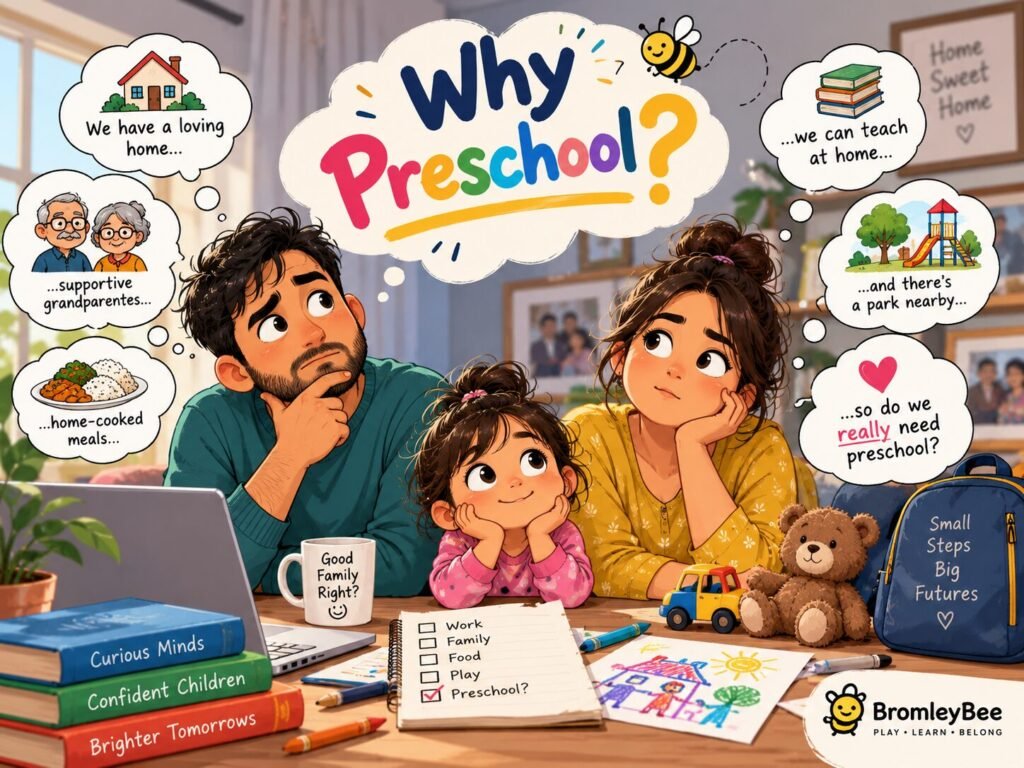
For generations, the early education of young children was largely considered a family responsibility. A young child belonged at home, surrounded by parents, grandparents and extended family, learning through everyday life.
Parents taught manners and values. Grandparents told stories. Children watched, listened, copied, asked questions and gradually learnt about the world around them. Formal education could wait until they were older. And, in many ways, there was enormous value in this.
So why has preschool become such an important part of childhood today?
The answer isn’t that families suddenly became less capable of raising children. Rather:
Our understanding of how young children learn and develop has changed enormously.
Research in psychology, neuroscience and education has helped us understand that children are active learners from the very beginning. The conversations they hear, relationships they form, games they play and environments they explore all contribute to their cognitive, social, emotional and physical development.
Preschool grew from this changing understanding of childhood — not as a replacement for family, but as an extension of the rich experiences children receive at home.
From Family Care to Early Childhood Education
The idea of educating young children through play is not particularly new.
One of the most influential pioneers was Friedrich Fröbel, a nineteenth-century German educator. In 1840, he introduced the name Kindergarten, literally meaning ‘children’s garden’.
It was a rather beautiful idea: children, like plants in a garden, should be given the right environment in which to grow.
Fröbel believed young children should learn through play, creativity, movement, nature and practical experiences rather than being pushed into formal academic instruction too early. His ideas gradually travelled beyond Germany. The first kindergarten in London opened in 1851, and in 1874 the Froebel Society for the Promotion of the Kindergarten System was established in England.
Behind all of this was an important change in thinking:
Children were no longer simply future pupils waiting to become old enough to learn. They were already learners.
Jean Piaget and the Curious Child
During the twentieth century, psychologists began looking more closely at how children actually learn.
One of the most influential was Swiss psychologist Jean Piaget. He challenged the idea that children simply absorb information given to them by adults, arguing instead that they actively construct an understanding of their world through exploration, experimentation and interaction.
Watch a young child playing with building blocks and this becomes surprisingly easy to see.
They build a tower. It falls over. They build it again, perhaps with the bigger blocks at the bottom this time.
Nobody needs to give them a lesson entitled An Introduction to Structural Engineering. Yet they are already experimenting with size, shape, balance and cause and effect — and, perhaps most importantly, discovering what to do when something doesn’t work the first time.
The same happens when children pour water between containers, dig in sand, complete a puzzle, invent a pretend shop or repeatedly ask that famous childhood question:
‘Why?’
What looks like ‘just playing’ to an adult can involve problem-solving, language, imagination, persistence and discovery.
Piaget’s theories have naturally been refined as research has progressed, but one of his central insights remains highly influential:
Young children learn by actively engaging with the world around them.
That principle sits at the heart of good early years education.
What Science Tells Us About the Early Years
Our understanding has developed considerably since Fröbel and Piaget. Modern neuroscience has given us a much clearer picture of just how active the developing brain is during early childhood.
UNICEF reports that:
More than one million neural connections can form every second during the first few years of life.
That sounds dramatic — because it is. But it doesn’t mean a three-year-old needs flash cards from breakfast until bedtime or a timetable worthy of a university student.
Quite the opposite.
Ordinary childhood experiences can be extraordinarily powerful.
Talking together. Reading a favourite story for what feels like the hundredth time. Singing songs. Playing peekaboo. Asking and answering questions. Exploring outdoors. Comforting a child when they’re upset. Letting them have another go when something doesn’t work.
Harvard University’s Center on the Developing Child describes responsive exchanges between children and caring adults as ‘serve and return’ interactions.
Think of a baby pointing at a bird. The child ‘serves’ by pointing, making a sound or looking towards the adult. The adult ‘returns’ by following their gaze and saying, ‘Yes, that’s a bird! Look, it’s flying.’
It seems like the simplest interaction in the world. Yet these repeated, responsive exchanges help support the developing brain, including the foundations of communication and social skills.
The early years are not simply the years before education begins. They are a fundamental stage of development in their own right.
Preschool Doesn’t Replace the Family
This distinction matters.
Recognising the importance of preschool does not mean traditional family care was somehow inadequate. Nor does it mean parents, grandparents or extended family have become less important.
Family remains the foundation of a child’s life.
Parents provide security, affection, identity, values and a sense of belonging. And for many Bangladeshi and South Asian families, grandparents, siblings, cousins and extended family can play an especially important role in a child’s everyday life.
Those relationships are immensely valuable. A good preschool doesn’t compete with them. It adds another dimension to the child’s world.
At home, a child might happily build a tower with their grandmother. At preschool, they may build one with three other children — and suddenly they have to explain their idea, listen to someone else’s, share the blocks, negotiate whose tower is taller and cope when somebody accidentally knocks the whole thing over.
The blocks haven’t changed. The learning experience has.
Preschool can offer new people, experiences and challenges, as well as regular opportunities to interact with children of a similar age, while home remains the child’s secure foundation.
Why Play Is Serious Business
Adults sometimes separate playing and learning as though one happens after the other.
For young children, they are often the same thing.
Imagine a group of children running a pretend café. One is taking orders. Another is ‘cooking’. Someone has decided everything costs five pounds, regardless of whether you’ve ordered a cup of tea or the entire menu.
It looks wonderfully chaotic.
But underneath the laughter, children may be practising conversation, turn-taking, counting, imagination, cooperation and problem-solving.
Play also gives children something particularly valuable: permission to get things wrong.
They can experiment, fail, change their minds and try again without feeling that they have failed a test.
A quality preschool therefore doesn’t simply replace play with worksheets and memorisation. It uses meaningful play and carefully planned experiences to help children learn.
Learning to Be With Other People
For many children, preschool is one of their first opportunities to regularly become part of a community beyond their family.
And being three or four years old in a room full of other three- and four-year-olds requires quite a few skills.
You have to wait. Share. Listen. Ask. Explain. Sometimes compromise.
And occasionally accept the devastating news that somebody else is already playing with the red car.
These everyday interactions matter.
Children gradually learn to communicate, cooperate, take turns, understand other people’s feelings and manage disagreements. They also become better able to recognise and express their own emotions.
These social and emotional skills develop through experience, relationships and guidance from responsive adults.
‘I Can Do It Myself’
Anyone who spends time with young children will eventually hear those words — sometimes at wonderfully inconvenient moments.
But that desire for independence is an important part of development.
At preschool, children have many small opportunities to do things for themselves: choosing an activity, putting something away, managing their belongings, asking for help, completing a task or making a simple decision.
None seems particularly remarkable in isolation. Together, however, they help a child develop a powerful belief:
‘I can try.’
And when it doesn’t work:
‘I can try again.’
That willingness to persevere can become far more valuable than getting every answer right the first time.
Language Is More Than Learning Words
Children develop language through interaction. Stories, songs, conversations, questions, role play and group activities give them opportunities not simply to hear language, but to use it for a purpose.
This is particularly relevant for many families in Bangladesh, where a child may speak Bangla at home while encountering more English through preschool and later schooling.
A thoughtful early years environment doesn’t need to treat one language as an enemy of another. A child’s home language is part of their family, culture and identity. Preschool can broaden their communication experiences while respecting that foundation.
The goal isn’t simply to teach another language. It is to help children become confident communicators.
Preparing for School — But Not Just with ABCs and 123s
Ask what ‘school readiness’ means and it’s tempting to think immediately of letters, numbers, colours and shapes.
Those things have their place.
But imagine two children starting school.
One can recite the alphabet perfectly but struggles to separate from a parent, follow a routine, ask for help or play alongside other children. Another may know fewer letters but can communicate their needs, manage simple tasks independently, cope with small frustrations and approach something unfamiliar with curiosity.
Which child is truly more ‘ready’?
The answer isn’t as simple as an academic checklist.
Preschool can help children become familiar with routines, group experiences and classroom expectations while developing communication, independence and early learning skills.
School readiness is academic, but it is also social, emotional and physical.
A good preschool helps bring these elements together.
Quality Matters
Simply attending a preschool does not automatically create all these benefits.
The quality of the experience matters enormously.
A good early years setting should offer:
- a safe and nurturing environment;
- warm, responsive and knowledgeable educators;
- meaningful opportunities for play and exploration;
- developmentally appropriate learning experiences;
- positive relationships;
- opportunities for movement and creativity;
- respect for individual differences and developmental pace; and
- strong communication between families and educators.
Parents should feel like partners rather than spectators.
After all, the preschool may know what happened between drop-off and collection, but the family knows the child in a way no setting ever can. Bringing those perspectives together provides consistency, understanding and support across both worlds.
Childhood Is Not a Race
Perhaps one of the most important lessons from everything we now understand about early childhood is also one of the simplest:
Earlier does not automatically mean better.
Childhood shouldn’t become a race to read first, count highest or complete the most worksheets.
Young children also need time to run, imagine, build, talk, wonder, create, make friends, make mistakes, get muddy, ask impossible questions and occasionally spend twenty minutes examining something an adult would have walked past without noticing.
These aren’t interruptions to learning.
For a young child, they are part of learning.
The early years should build the curiosity, confidence, independence, emotional security and love of discovery that make later learning possible.
Final Thought: Giving Children the Right Foundation
The story of early childhood education reflects how much our understanding of children has changed.
Fröbel helped popularise the idea that children learn through play and experience. Piaget helped us see children as active participants in their own learning. Modern research has taken our understanding further, demonstrating just how significant early relationships, experiences and environments can be.
None of this diminishes the role of the family.
It strengthens it.
The best early education isn’t about choosing between home and preschool. It is about allowing the two to complement one another.
Home gives children their roots. Preschool gives them space to explore, grow and spread their wings.
Preschool shouldn’t rush childhood. It should understand it – giving children opportunities to play, explore, communicate, build relationships, make mistakes and discover what they can do.
And when the time comes to walk through the doors of mainstream school, children need more than letters and numbers. They need confidence, independence, curiosity and social and emotional security.
Perhaps most importantly, they need to believe that learning is something worth being excited about.
That is the true value of preschool. It isn’t simply preparation for school. It is part of the foundation for a lifetime of learning.
Sources & Further Reading
- UNICEF — Early Childhood Development: Early brain development, relationships and the importance of children’s early experiences. UNICEF: Early Childhood Development
- Harvard University — Serve and Return: How responsive interactions between children and caring adults support healthy development. Harvard: Serve and Return
- Harvard University — Brain Architecture: How early experiences and relationships help shape the developing brain. Harvard: Brain Architecture
- Froebel Trust — Friedrich Fröbel: The history of Fröbel, kindergarten and the development of Froebelian early education. Froebel Trust: History of the Froebel Movement
- The Open University — Jean Piaget: An introduction to Piaget’s influential ideas about children’s cognitive development and active learning. The Open University: Jean Piaget and Child Development
About the Author
Director, BromleyBee Early Years
Alia Ashrafi is Director of BromleyBee Early Years, with a background in early childhood education, health and social care, and experience of UK early-years practice. Her work focuses on how nurturing relationships, purposeful learning and strong partnerships with families can help children thrive during their earliest years.